Conceptual solution for a settling tank drainage issue
Process engineering
This case describes how we used basic process engineering to restore the gravity drainage of excess water from a settling tank. The focus is on hydraulic analysis, concept choices and a robust solution that is easy to operate.
About the case
Context:
The settling tank receives a variable inflow from several presses and sludge pits. Due to restrictions in the internal discharge to the collector ring and in the external pipe routing, the level kept rising, resulting in downtime. Foam and deposits limited the effective flow. The aim was to discharge the surplus continuously and by gravity without adding complexity.
Approach:
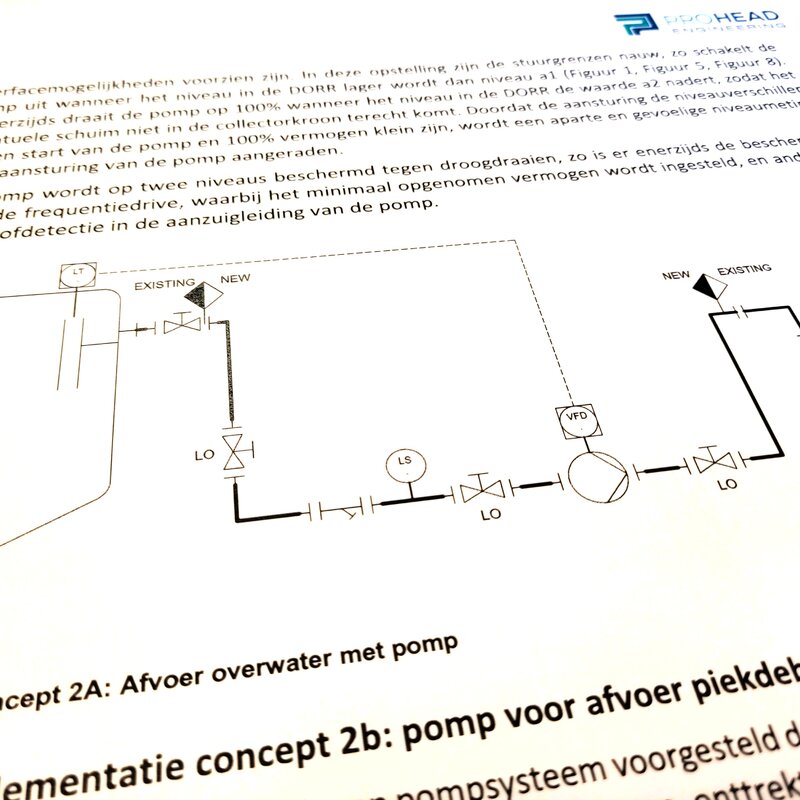
We first analysed trend data of the tank level to determine the additional discharge flow required. We then optimised the internal hydraulics by enlarging the passage between the separators and the collector ring, so that discharge starts earlier and more evenly and the effective buffer capacity per millimetre of level increases. For the external discharge, the piping was recalculated using the Darcy–Weisbach method, including local losses, and scenarios with larger nominal diameters were compared. Alternatives such as a parallel line, a pump variant and water jet/eduction were briefly weighed on capacity, maintenance and fit.
Result:
The chosen solution is a fixed pipe routing with a larger DN combined with a modification to the separators designed by us. This configuration provides the required capacity margin, reduces foam carry-over to the collector ring and makes maintenance predictable through strategically placed cleaning points. Options such as a parallel line or a pump remain available as future peak shavers but are not needed for basic operation. The installation thus remains simple, reliable and scalable.