Basic engineering for process tank ventilation
Process engineering
Assessment of vapour formation and ventilation capacity in an atmospheric process tank. Objective: keep the headspace stable and discharge emissions in a controlled way, without unnecessary complexity.
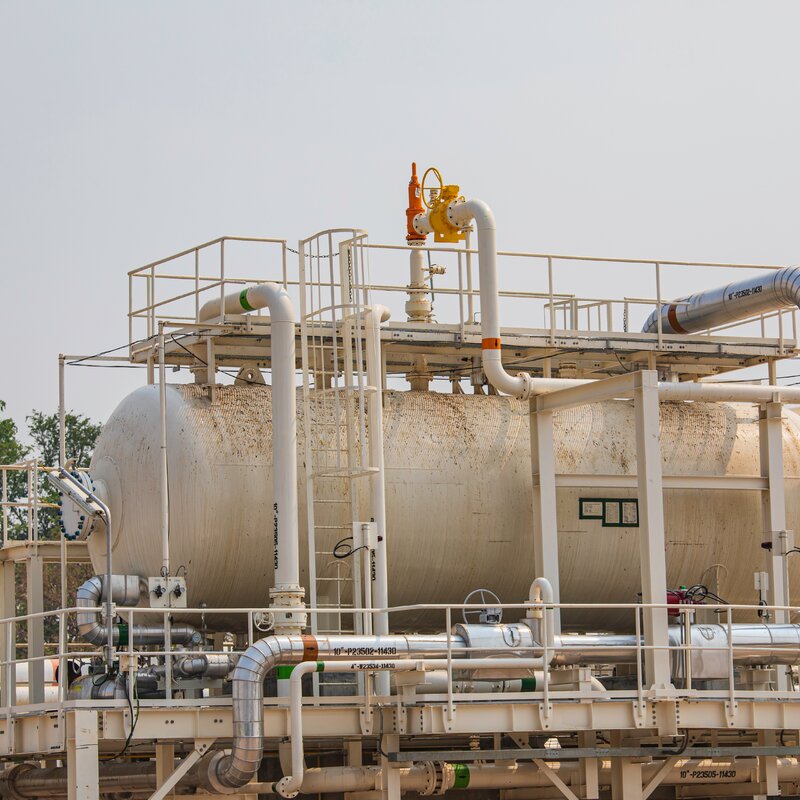
About the case
Context:
The tank receives an aqueous stream containing traces of DIPE (di-isopropyl ether), is fitted with an agitator and has forced ventilation. Because DIPE is volatile, it can accumulate in the vapour space. We wanted to estimate which ventilation setting is needed to keep concentrations in the headspace under control and low.
Approach:
Assumptions: steady-state operation, liquid homogeneously mixed by the agitator, sufficient mixing in the gas phase through ventilation.
Equilibrium approach: gas-phase concentrations of DIPE estimated via Henry's law equilibrium.
Ventilation comparison: natural draught (roof penetration) compared qualitatively with the existing forced ventilation.
Guidelines checked: the classification approach from IEC 60079-10-1 was used as a sanity check against an operational guide value of 10% of the LEL (Lower Explosive Limit).
Result:
The analysis shows that the forced ventilation keeps DIPE concentrations in the headspace well below the operational guide value. Natural ventilation alone is not robust in unfavourable weather conditions, so forced extraction remains the preferred option. The equilibrium approach used provides a conservative upper bound, so the ventilation setting was chosen with sufficient margin. Recommendation: periodically verify the ventilation flow and operating temperatures so that the underlying assumptions remain valid.