Safety upgrade of a breaker line for recycling
Machine safety
When full conformity of a complex industrial line is no longer economically feasible, we speak of a safety upgrade. The line is made inherently safer with conformity in mind, but without the explicit goal of achieving that conformity immediately.
About the case
Context:
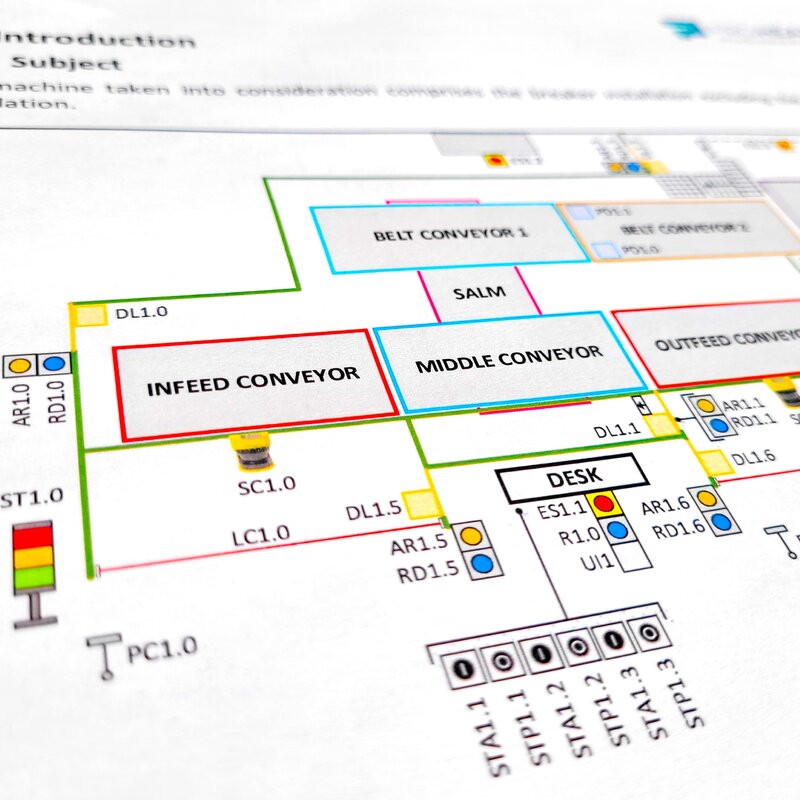
An industrial client used a breaker installation to grind rejected calcium silicate boards into dust and reuse it as raw material. The line consisted of three parts:
- a depiler that automatically separates stacks of boards and feeds them in via conveyors,
- a breaker (primary breaker + two secondary breakers) that grinds the boards,
- and a deduster that extracts the dust and conveys it to silos.
Because the installation had been in operation for years, the safety control system no longer met current standards. The client asked Prohead Engineering to develop and validate a safety upgrade.
Approach:
The project comprised three steps:
1) Risk assessment
- Systematic identification of hazards during use, maintenance and malfunctions.
- Determination of the required performance levels (PLr) according to EN ISO 12100 and EN ISO 13849-1.
- Mapping of safety functions in a shutdown matrix.
2) Design & diagrams
- Development of modified electrical diagrams with a focus on safe shutdown and interlocks.
- Prohead Engineering made numerous comments and improvements, e.g.:
- Replacement/selection of safety relays/safety PLC with SIL/PL data (traceable failure data).
- Deduster/breaker interlock: no run without extraction + alarm & safe stop on failure.
- Clear references & coding of emergency stop circuits; uniform choice of symbols.
- Physical separation of control and power circuits + separation of safety I/O from standard I/O.
- Earthing & equipotential bonding optimised (from both an interference and a safety point of view).
- Guard locking with controlled reset and relocated reset points for a clear view of the danger zone.
- Light curtains correctly positioned (safety distance, range) and included in the safety chain.
3) Validation
- Verification of architecture, SFF, DC, MTTFd against the intended PL.
- Functional tests: emergency stop, door/guard lock, light curtains, permissives, reset logic, deduster interlock.
- Validation report with test reports, measurement sheets and setting values.
Result:
- Safety functions demonstrably at the required PL; reset and diagnostic logic clear and reproducible.
- Audit-ready technical file: RA, diagrams (as-built), component lists with safety data, test reports.
- Reliable operation: fewer spurious trips thanks to better separation, cabling and alarm rationalisation.
Added value:
Prohead combined risk assessment, schematic engineering and validation into one conclusive upgrade. The breaker line is now compliant with standards, safe to operate and easy to maintain, with clear documentation for inspections and future modifications.