EN ISO 14119 vs. EN 1088 — interlocking devices associated with guards
Machine safety
EN 1088 has been replaced by EN ISO 14119, with a modern framework for interlocks, defeat prevention and series connection. This article summarises the main differences and pitfalls — including what you can and cannot expect in terms of achievable PL.
EN 1088 has been replaced by EN ISO 14119. The standard sets out principles for interlocking devices associated with guards, with close attention to defeat prevention, correct selection/positioning and series connection (“fault masking”). Among other things, the 2024 edition adds a normative Annex J on fault masking in series connections.
Interlock types:
- Type 1/2: mechanical (uncoded/coded)
- Type 3/4: non-contact (uncoded/coded, e.g. magnetic/RFID)
- (2024) Type 5: trapped-key interlocking (previously dealt with separately)
Note: the type does not determine the PL. PL e normally requires a redundant architecture (Cat. 3/4) with sufficient DC and MTTFd. A single interlock (single channel) will not achieve PL e.
Coded interlocks (resistance to defeat):
The standard distinguishes between low/medium/high level coding. Higher coding = harder to defeat. Ranges such as 1–9 / 10–1000 / >1000 are practical guidelines from manufacturers' documentation, not binding text of the standard — choose the level based on your risk assessment and the expected motivation to defeat.
Guard locking & forced opening:
Magnetic locks without a mechanical bolt are permitted, provided the holding force demonstrably meets the requirements. After forcing, re-enabling must be arranged so that an unsafe rapid restart is impossible (e.g. a delay/inhibit function); a fixed 10-minute rule is not a requirement of the standard, but is sometimes used as an example.
Series connection & “fault masking”:
In a series connection, faults can be masked. Solutions: individual channels, a safety bus, or interlocks with diagnostics; the chosen solution affects the DC and therefore the achievable PL. See Annex J (2024).
Manufacturer's responsibility (defeat prevention):
Design in such a way that defeating is not needed for operation/maintenance:
- Restrict access to the switch/actuator, conceal or shield them;
- Prevent substitutes (e.g. a loose “fork”) by using unique/coded actuators;
- Limit the possibility of dismantling (welding, riveting, gluing);
- Monitor/test in the control system (test cycles, fault detection).
- The standard provides an overview table with measures for each situation.
Rarely opened guards:
For rarely opened doors, periodic testing is mandatory; the control system must monitor this and stop safely if the test is not carried out.
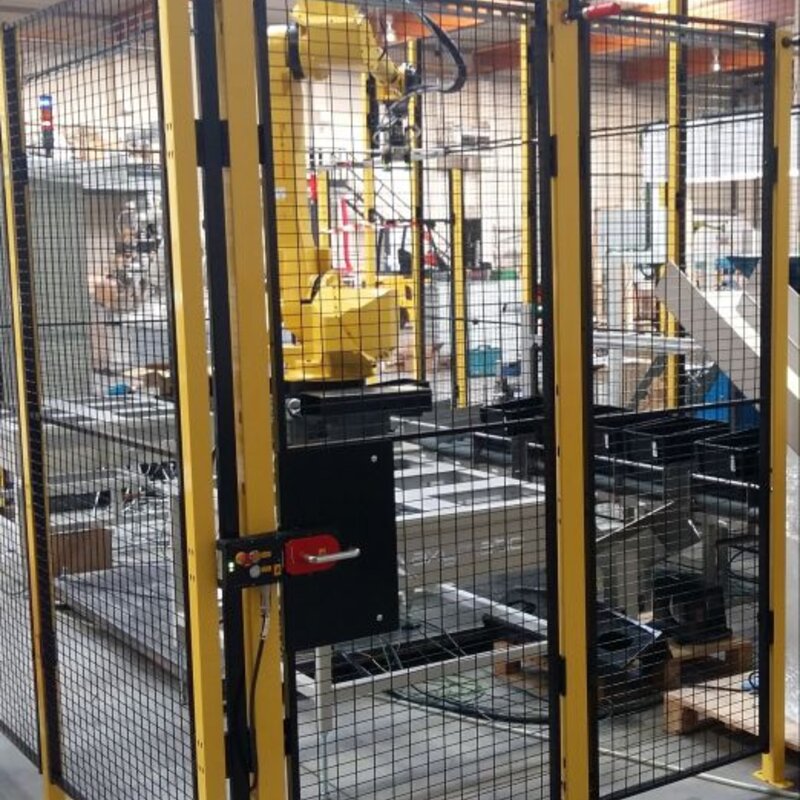
Case: Safety upgrade of an assembly with collective guarding